Audicin x Oura Integration: Our Closed Loop Auditory System Is Here (iOS Beta)
Every Audicin session starts with a question: what does my nervous system need right now?
Until now, you were the one answering that question. You'd open the app, think about how you felt, and pick a journey or a song (focus, calm, sleep) based on your best guess.
A good guess, usually. But still a guess.
That is all changing, starting with our new Audicin x Oura integration, now in beta testing on iOS.
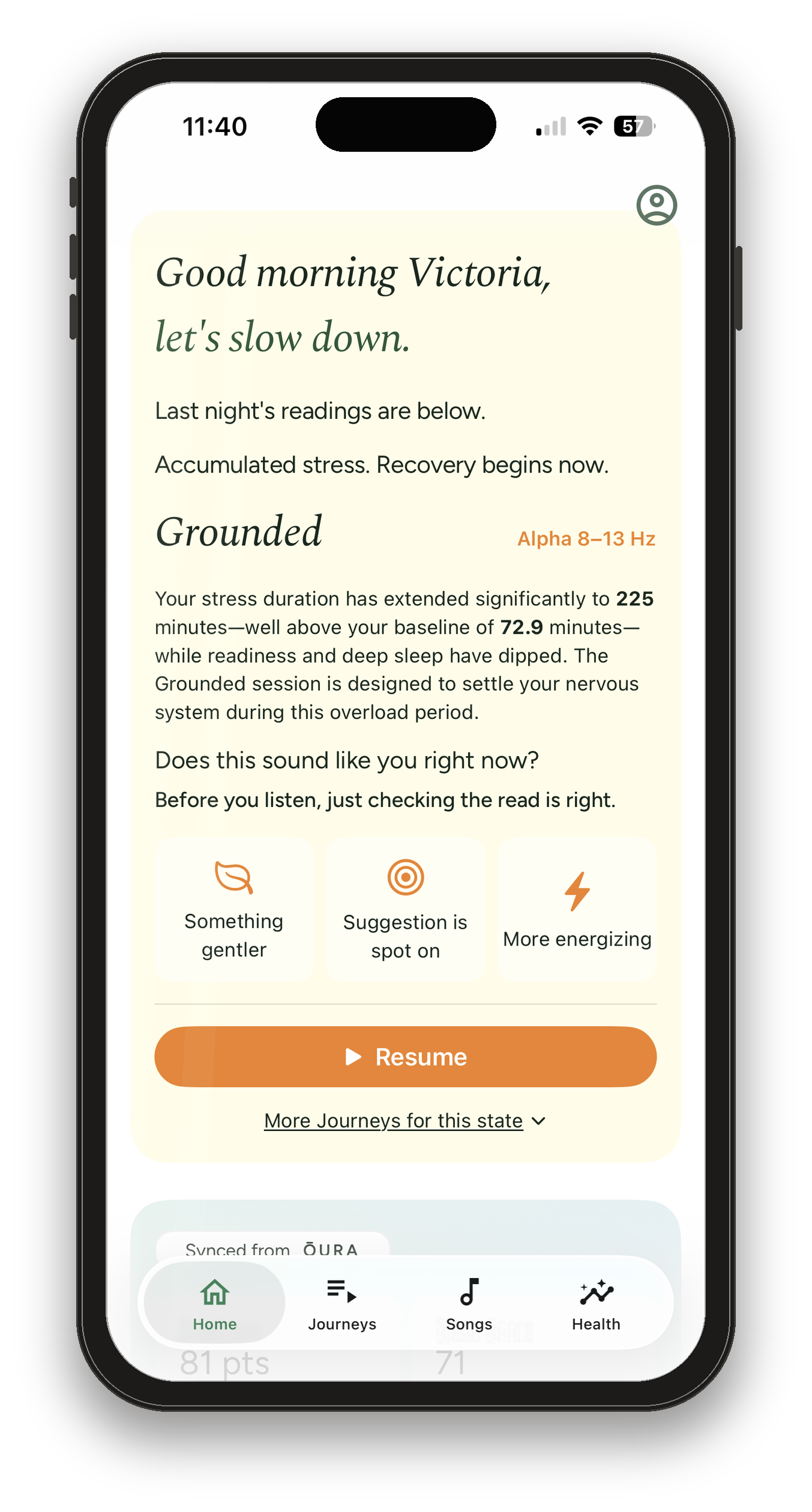
For the first time, Audicin closes the loop between your biometric data and the neurosound you listen to, by reading how your nervous system is doing and recommending the journey built for that exact state. No picking. No guessing. Just the sound you need, waiting for you.
What Is a 'Closed Loop Auditory System' ?
A closed loop auditory system is one that senses, evaluates, and responds without you in the middle of it. Here's how the Audicin closed loop auditory system, or CLAS, actually works:
- Your Oura ring collects the data overnight and throughout the day before. This includes HRV, resting heart rate, readiness, and sleep score.
- Audicin reads a special selection of that Oura data each morning. Not a single snapshot, but the pattern across your prior day and your overnight recovery.
- Our proprietary engine evaluates your biometrics against your baseline to determine where your nervous system is actually sitting that day: primed and sharp, fatigued, wired, or still recovering.
- Audicin recommends the neurosound journey built for that state, ready before you've had to think about it.
This is not a live, continuous readout. It is a daily assessment, built from your overnight and prior day Oura readings, that gets sharper the more consistently you use it.
The reason that the CLAS is built this way is that your core nervous system state does not reset completely minute to minute; it carries the last 24 hours with it, and that is exactly what the Audicin engine is designed to read.
But we offer two recommendations every day, not just one. To respect the fact that we have very different day and evening needs, the Audicin CLAS changes recommendations around evening time, to promote and support sleep preparation as the day comes to a close.
Why We Built an Oura Integration CLAS
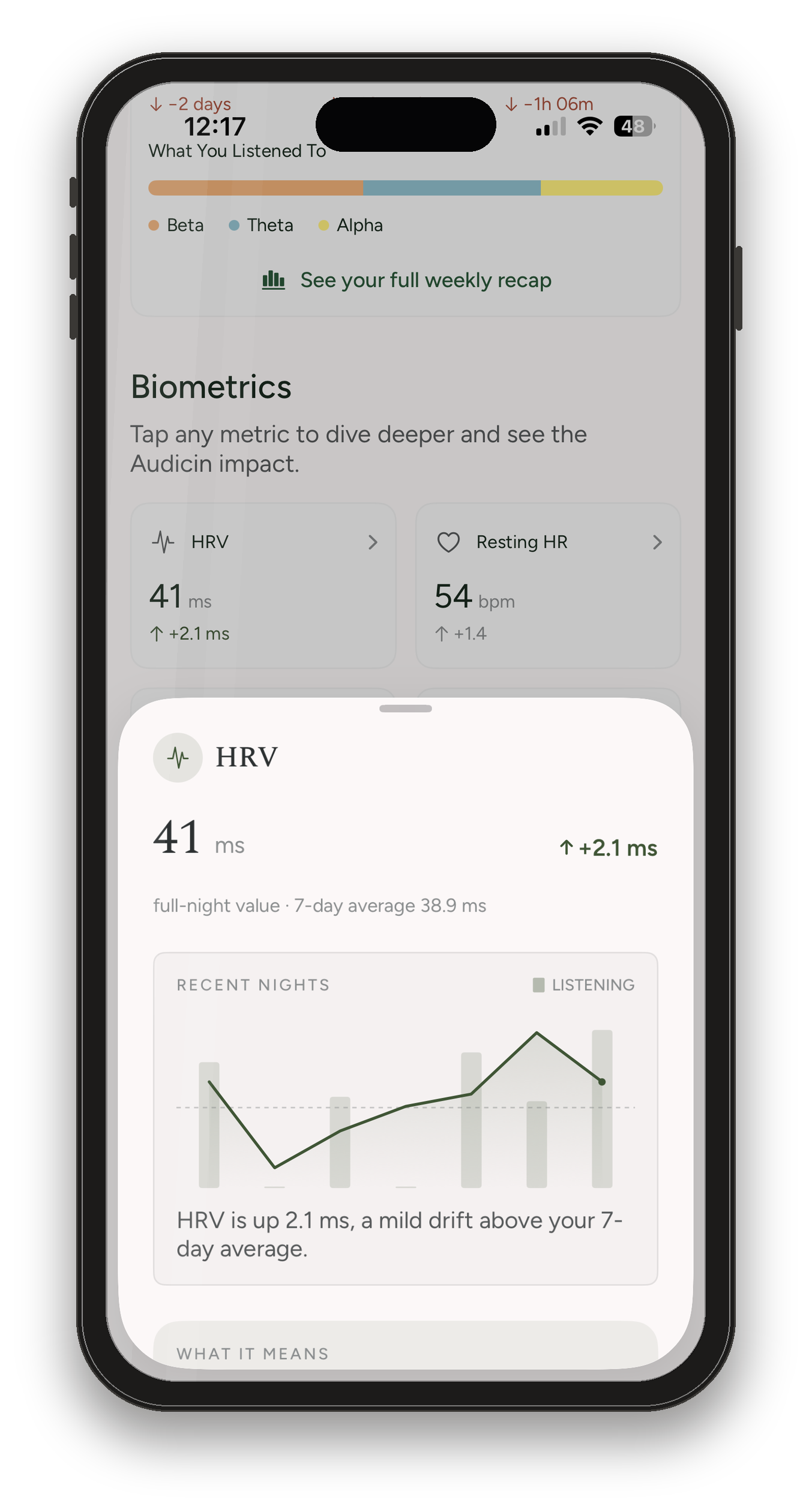
I've written before about how sound interacts with HRV, and how structured neurosound can influence breathing, vagal tone, and autonomic balance without any conscious effort from the listener. In our two week study with frontline nurses, we saw a statistically significant 21.9% increase in HRV across Audicin listening sessions.
That research confirmed to us the Audicin sound works. What it did not solve was matching: making sure the right sound reaches someone in the state that needs it most.
Biometric data was the missing piece to creating our closed loop.
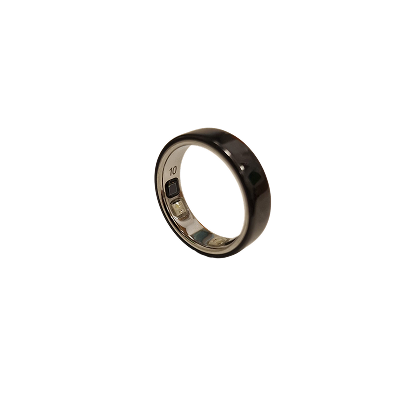
We chose Oura for our first full CLAS system because it is one of the best tools available for reading the nervous system day to day. Oura's HRV tracking is best in class, captured overnight during sleep when readings are most stable and least noisy, and paired with resting heart rate, readiness, and sleep score, it gives a genuinely complete picture of where someone's autonomic nervous system stands.
Oura already does the hard work of turning sleep, strain, and recovery into something measurable. Our job was to build the engine that turns that measurement into a recommendation, automatically, every day.
Where the Audicin Sleep Headband Fits In
The loop does not stop at the app. If you use the Audicin Sleep Headband, that usage feeds back into the system too, so the engine is not just reading your Oura data. It can take into account what you actually did with it overnight.
A quick refresher on the headband, for anyone who has not tried it yet:
- Preloaded with Audicin's 1 Hz delta brainwave journey for deep, restorative sleep
- Completely Bluetooth free, no phone or app required to use it
- Ultra thin flat speakers, side sleeper friendly
- Up to 20 hours of battery life
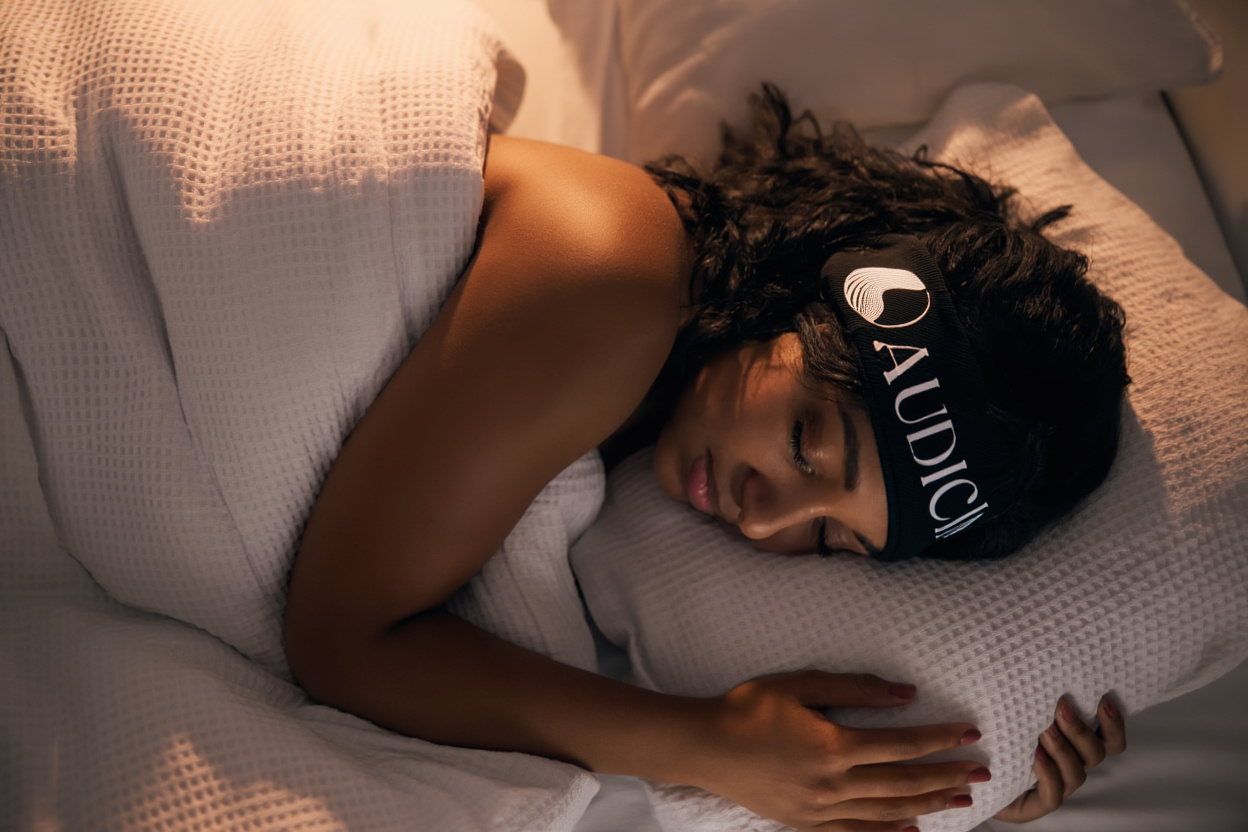
It is designed to work standalone. Paired with the Oura integration, it becomes part of the same closed loop auditory system: your overnight sound, your overnight biometrics, and tomorrow's recommendation, all connected.
If you do not have the headband yet, use code SUMMER20 at shop.audicin.com for 20% off, at the time of writing.
How to Join the Audicin Oura Beta
The Audicin Oura integration is currently in beta, available on iOS only, for anyone who owns an Oura ring.
If that is you, we would love your help testing it. Head to our Contact Us page and send us a note. We will get you set up with access and details.
This is the first time we have been able to close the loop fully: sensing, evaluating, and responding, without you having to do any of the work in between. We are glad to finally be testing it in the real world, and we want you in the room for it.
Frequently Asked Questions
What is the Audicin closed loop auditory system? It is a system that reads your Oura biometric data each day, evaluates your nervous system state using Audicin's proprietary engine, and automatically recommends a matching neurosound journey.
Which devices support the Audicin Oura beta? The beta is currently available on iOS only, for users who own an Oura ring.
How do I join the Audicin Oura beta? Visit the Contact Us page and send a note requesting beta access.
Does the Audicin Sleep Headband work with the Oura integration? Yes. Headband usage feeds into the same closed loop system, so your overnight sound session is factored into the next day's recommendation.
Related reading:
- Can Sound Actually Shift My HRV?
- Why You Still Feel Tired After Sleep
- Getting Started with Audicin: A Simple Guide