
What Are Binaural Beats and Why Headphones Matter

People often ask our team two closely related questions:
- What are binaural beats?
- Why do we recommend wearing headphones when listening to Audicin?
Here are the answers!

First: What is Audicin ?
Audicin is not simply “music with binaural beats added in”.
There is plenty of that on the market, though you should know that an independent engineering study in 2025 reported that around 92% of them are fake. They contained either no beats at all or the wrong ones. If you are interested in learning more about that issue then here is my blog on the great Binaural Beat scandal.
Audicin is a science-based background listening experience made up of three elements that work together.
1. Soundscapes composed according to neuroscience and biology.
We design our soundscapes using evidence-based principles about how background music supports sleep, relaxation, focus, and recovery. This includes choices around tempo, harmony, timbres, predictability, dynamics, and how sound unfolds over time. Even without any processing, the music itself is carefully designed to cue your brain, support your nervous system and help you move toward your goal state.
2. Binaural beats that are expertly engineered, mixed, and mastered to remain subtle and unobtrusive.
More on binaural beats next. But for now, it is important to say that these beats are not meant to be heard as a separate layer. Most people never notice them in Audicin because they are skillfully hand-embedded into our soundscapes in a way that feels natural and comfortable, so the experience remains musically enjoyable rather than grating, computerised or technical.
3. A 360-degree audio environment.
This supports spatial sound perception and immersion, which makes the listening experience feel deeper and more enveloping over time, wthout distracting from the task at hand. This sense of space is part of what helps Audicin feel calming and supportive rather than flat or fatiguing.
Brought together for the first time by experts in brain science, sound engineering and musical aesthetics, these three elements create a powerful listening experience that supports the brain without demanding attention or effort from the listener.
So, what are binaural beats?
A binaural beat is created when your brain receives two slightly different sound frequencies, one in the left ear and one in the right ear. The brain detects the difference between the two frequencies coming from the two ears and generates a rhythmic pattern internally to 'fill in the gap'. This is the 'beat'
For example, if the left ear hears a tone at 200 Hz and the right ear hears a tone at 210 Hz, the brain responds to the 10 Hz difference between them. That internally generated rhythm at 10 Hz is the binaural beat. This process only works when each ear receives its own distinct signal.
What do different binaural beats do?
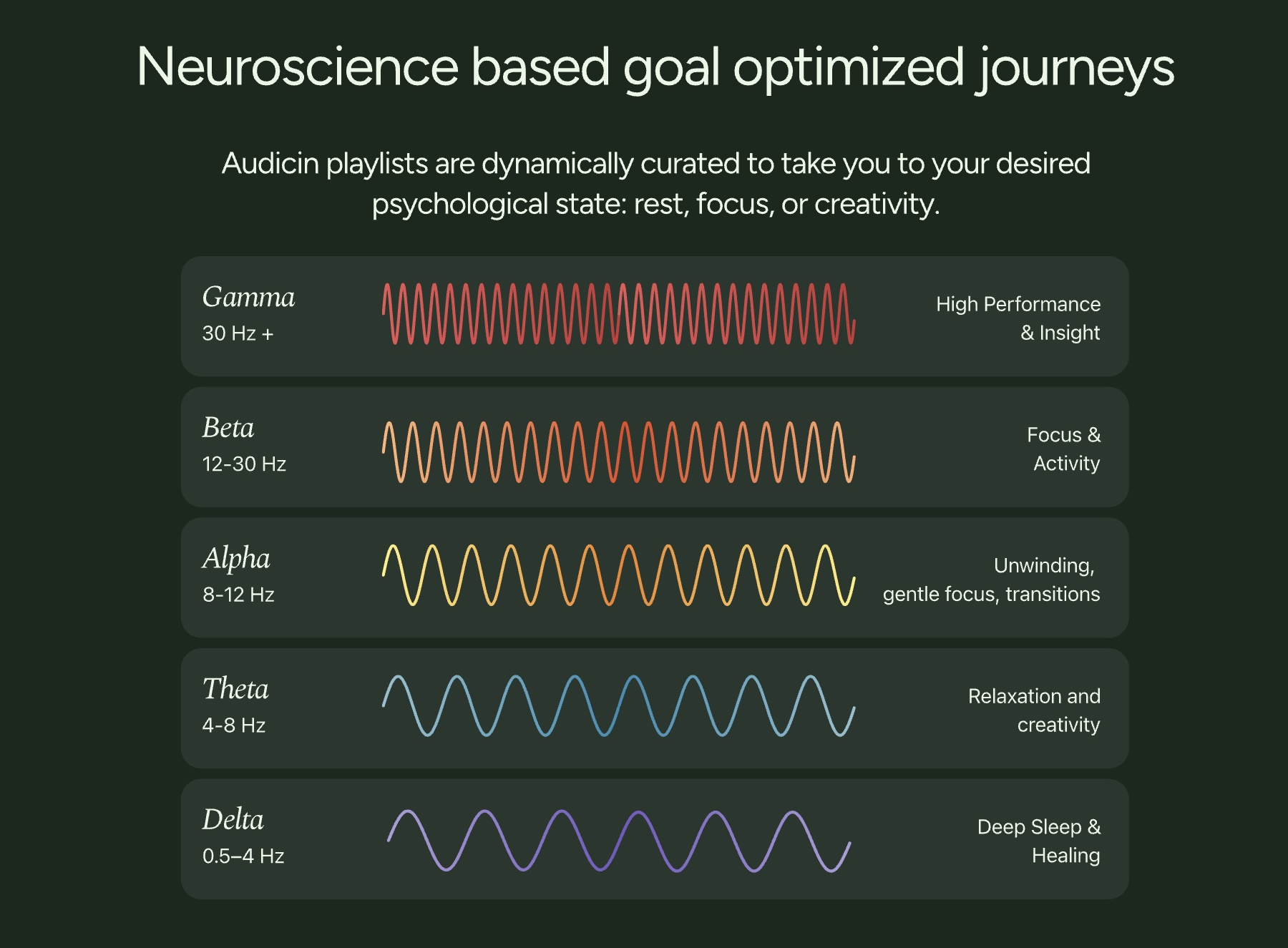
Binaural beats can be generated at different speeds, which roughly correspond to different brain activity patterns that occur naturally as we go about our day.
Slower beat frequencies are associated with relaxation and sleep, mid-range frequencies with calm focus, and faster ones with alert attention.
What is 'brain entrainment' ?
Brain Entrainment is how Audicin supports these different states.
The term refers to the brain’s natural tendency to synchronise with rhythmic input. In the same way that we tap our foot to a good beat, our brain likes to follow a good rhythm.
When the brain is exposed to a gentle and consistent rhythm, like a binaural beat, it aligns with it. This does not force the brain into a particular state. Instead, it supports certain states and makes them easier to access. This is why binaural beats, when embedded subtly into soundscapes, gently support states associated with relaxation, focus, or sleep by making those rhythms more accessible to the brain.
This is also why the effects are often described in simple terms, such as feeling easier to settle, drifting into focus more smoothly, falling asleep faster, or feeling calmer without feeling sedated.
Why headphones are essential ...
Because binaural beats depend on separate left and right signals reaching the brain.
When sound is played through speakers, the left and right channels mix in the air before they reach your ears. Once that happens, the brain no longer receives two distinct signals, and the binaural beat effect is lost.
With headphones, the left ear receives the left signal and the right ear receives the right signal. This allows the brain to generate the binaural beat internally, as intended.
This is why we say that Audicin works without headphones, but works best with them. The music on its own can still be supportive and effective. The largest impact, however, comes when the binaural beats and the 360-degree audio environment are delivered correctly through headphones.
...But any headphones are fine
You do not need specialist equipment to benefit from Audicin.
AirPods are fine. Over-ear headphones are fine. Basic wired earbuds are fine. Even the simplest, most affordable earbuds will work. What matters is not sound quality or price, but that the left and right channels are delivered separately to the brain.
As long as each ear receives its own signal, the binaural beat mechanism and the 360 degree sound engineering can do their job.
Knowing that it can be tricky to sleep in headphones, Audicin has a solution for those of you who would like to enjoy our most popular sleep soundscape through the night. Check out the Audicin sleep headband, a comfortable and effortless blue-tooth free way to guide your brain to restorative deep sleep.

Any volume is fine - but we recommend low
Another quick note, people often ask me if Audicin is better if played with more volume. No. Asbolutely not. There is no evidence that ramping up the volume increases the effects of Audicin, or any binaural beats. All that this will do is risk your hearing.
As with any listening experience, keep the volume only as loud as you need to perceive the music. Having said that, it is important to clarify that Audicin won't work with volume set to 0.
No volume = no sound signals: no change in the brain.
As long as you can hear the sound, even quietly, then Audicin will work.
Why Audicin feels different
A key part of our design philosophy is that the sound should stay in the background. You do not need to listen for our beats, concentrate on the sound, or actively engage with the process. You simply pop on your headphones and press play.
The sound creates the environment and the engineering quietly supports the brain’s response underneath. The result is a listening experience that feels natural and effortless while still being grounded in neuroscience.
What you need to know
Audicin works as sound alone, but listening to it with headphones gives you the full effect. Any headphones will do and low volume is fine. Audicin supports your brain to be in the state you need, all the way from deep sleep and relaxation up to focused and creative, by gently encouraging a shift to your ideal rhythm.
Experience Audicin today by clicking here to get a code for 30 days free