
Restoring Cognitive Control Under Fatigue

Mental fatigue has a way of slipping in quietly. It slows reaction time, weakens attention, and makes the mind wander at exactly the moments when clarity is most needed. In high-performance environments such as military units, elite sport, aviation, emergency medicine, this drift isn’t harmless. It compromises precision, decision-making, and situational awareness.

A study by Axelsen, Kirk, and Staiano (2020) at the University of Southern Denmark gives us a deeper understanding of how the brain responds when pushed to its cognitive limits, and more importantly, what can pull it back so that performance survives pressure.
What Happens When the Brain Fatigues
Participants in the study completed a demanding 90-minute continuous performance task designed to induce mental fatigue. The task is called the AX Continuous Performance Test (AX-CPT) and it has been used in psychology studies since the 1950s. The physiological and cognitive signatures of doing the AX-CPT were unmistakable. Heart rate increased. Self-reported fatigue increased. Error rates climbed.
This kind of decline reflects a drop in cognitive control that we all recognise from demanding work, when the brain’s ability to sustain attention, regulate impulses, and stay anchored to the task drops away. Once cognitive control level dips, the margin for error widens.
The Interventions Tested
After inducing fatigue with this very demanding and long lab task, the researchers introduced different 12-minute interventions: a binaural beats audio track composed specially for the study (beta binaural beats at 14Hz), a guided mindfulness meditation track from Headspace, or a basic rest period with no audio. There was also a group of experienced meditators who had previously completed four weeks of Headspace training, who listened to the same guided meditation track as the novices.
What Stood Out
The binaural beats group maintained their performance almost perfectly, despite the pressure on their sustained attention.
You can see in the graph below taken from the paper, that the binaural beats groups' two columns don't differ from phase 1 to phase 5 of the study. Their performance level is maintained from before to after the tiring task. All other groups get significantly worse.
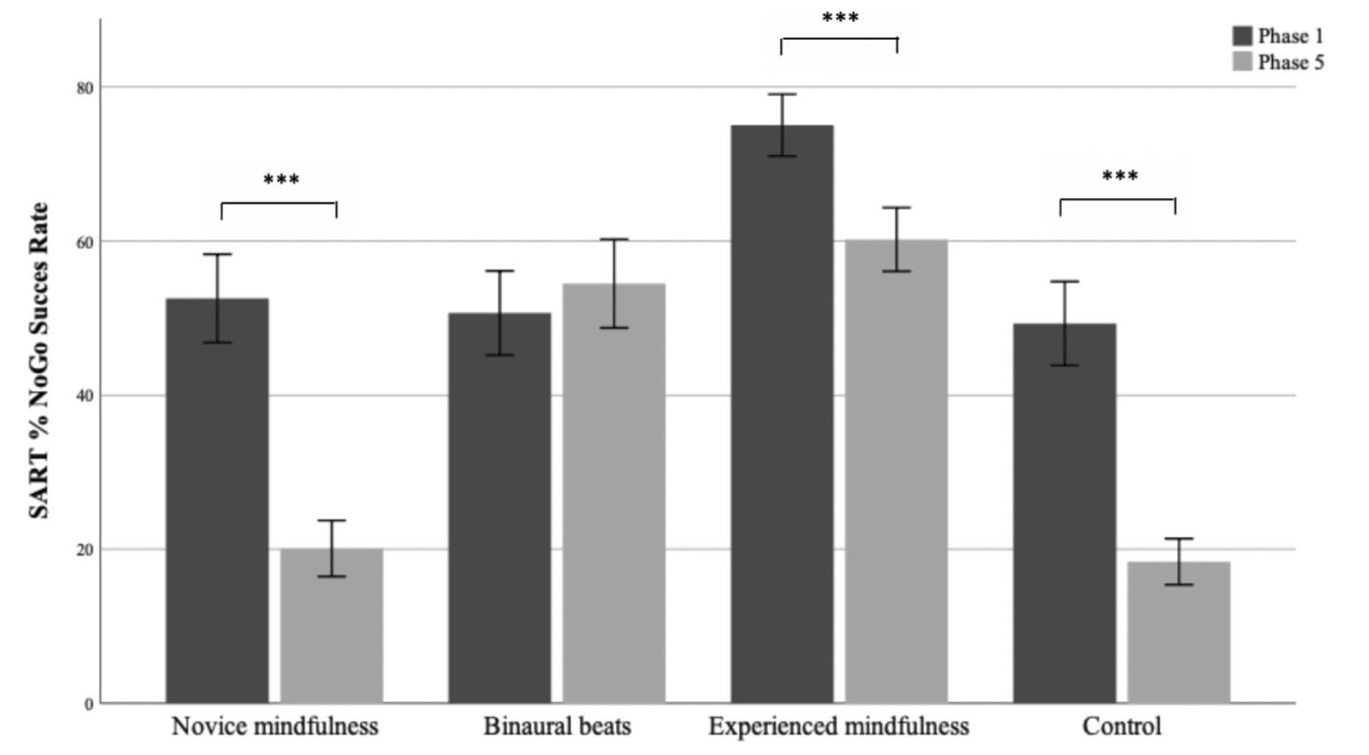
The sustained-attention score of the novice binaural beats group actually rose slightly after the fatigue period, while the novice mindfulness and control groups declined sharply.
The experienced mindfulness group performed well overall, though their strength came from weeks of prior training. And their performance was still significanrly impaired under the pressure of performing the AX-CPT over a long period of time.
This demonstrates that a person without any meditation training can still restore cognitive control quickly, with the right kind of audio intervention.
Why Auditory Stimulation Is So Effective in Demanding Environments
Auditory interventions do not require stillness, eyes-closed effort, or training. They influence the nervous system through sensory channels and deep brain systems that operate even when the body is active and the mind is partially taxed. The study’s binaural beats track produced improvements within 12 minutes, without any instruction beyond wearing headphones.
That kind of accessibility is rare in cognitive recovery. It allows individuals to regulate the nervous system in real time, whether they are in a staging area, in transit, or between high-pressure evolutions.

Where Audicin Fits In
This is the space Audicin was built for.
The individuals we serve such as operators, athletes, pilots, medical teams, do not always have the luxury of stepping away for extended recovery. Their work continues. Their environment doesn’t pause. Yet their nervous system still needs support.
Audicin provides that support by using auditory neuromodulation - the new player in neuroergonomics - to guide the brain back toward a steadier, more focused state. The goal is simple: help people regain cognitive control on the go, without adding cognitive load, without effort, and without interrupting the mission.

A More Sustainable Way to Perform
Mental fatigue is inevitable in a high performance environment. Losing focus doesn’t have to be. The study reveals that the brain is more responsive - and more recoverable - than many people realize. And it doesn't demand time or effort. It is the very definition of working smarter not harder. Through the right kind of auditory stimulation, cognitive control can be restored even while the demands of the day continue.
For high-performance individuals, that shift is more than a scientific detail. It is a way of sustaining clarity, steadiness, and readiness when it matters most.